


Keep reading to find my written reflection on creating a story map (pictured above) based on engaging with a sit spot (a part of nature you return to in order to build a relationship), the steps and data collection I did to do so, and my long-form land acknowledgment reflection.
Story Map Reflection
1. The view over the hill was enticing and I looked up at the tall trees moving in the wind and I wanted to watch them sway. I could lay down and see the sky and gaze over the hill to see the willow hanging over the pond. On my second visit I came from a different direction and saw the deeper reds of the familiar young maples making a brush and felt welcomed onto the warm dry soil under a fruiting hawthorn tree. In my story map “Over the Hill,” I capture the enticing feeling in poetic prose on the back of my legend, and it began as a short poem on the back of my sit spot chart:
Sweet visions and wind that warms your insides wait atop the hill where young maples grow in a brush, and towering red pines and hawthorns overlook your shining eyes. Careful tread but wary not because your heart waits in warm water under the hawthorn dotted shade under an open sky.
2. I always notice the soils because there is a sense of responsibility when you are stepping for your safety and others. When I looked down on my first visit, I saw the grander scape of hardening ground from colder nights and the bouts of rain that kick up soft mud were coating fallen pine needles. The bubbly way soft mud coats things on the surface makes me smile and I lifted the needles to investigate whether it was the rounded end of the needle or just the way mud behaves, and it was just the mud’s formation of choice. I noticed the dried brown leaves stuck to my sleeves when I laid down and they wafted volatile oils when I crunched them in my fingers. I am cautious of the hawthorn tree’s prickles, and felt how sharp the tip is with my finger. When I went to lie down I did so with care and removed a sharp thorn from the ground where my back was exposed.
3. On my first examination I attributed the soil’s slippery-soft parts and drying patches, which were warm to the touch, to the fact that it is an in-between season (fall). I know it is autumn because of the cool breeze and the green shedding from the leaves, brightening them to red, but the soils were in fact interconnected with the species of tree they were hosting and the kind of drainage they thrive in. The slippery-soft parts of the ground were supporting the red pines, and the warm dry patches were around the hawthorn trees. I noticed the berries and cones on the ground and how the leaves fall to cover them and soon turn to nourishment for the soil that would hold these tree’s fruits and support them to grow into strong relatives.
4. Overall, Zimanyi et al. (2020) highlighted the power of nature engagement, that it is “something that engages mind, body, heart and spirit together” (p. 4). This was my experience at my sit spot just by engaging with the land in a more significant way and taking the time to listen and learn from my surroundings and relatives. My spirit flows easy when there is silence and brushing wind, it feels like a decadent treat to breathe and something quiet says and there is room for me. My heart and spirit lift when it’s quiet and empty, and it feels easy because I love where I am and how I can show this in a deeper way is by singing a sweet song. Relating to the plants and animals from the perspective that they have been in right relationship with this land for much longer than me, so I watch what they do and acknowledge them by name and offer my respect. I am smiling up at the hawthorn tree so genuinely I wonder if it's healing me spontaneously. My heart feels like its in a warm bath with the hawthorn spreading over me. I try to imagine sending the love back to the tree in a circle between its root system and me. When I watch what my relatives do, I feel my curiosity surge and the varied ways of learning come online, and I am prompted to explore them by engaging them into my “play” by writing creatively. I see azure skies contrasting the rich shades of red leaves and bubbly juniper trees nearby and my mind and pupils expand being in the present of this colour and texture harmony. My curiosity prompts me to touch gently, turn things over, follow a fleeting glance of something that tucked behind the brush. My sense of responsibility prompts me to untangle a plastic wrap from drying out plant stalks. This sense of responsibility is affirmed by what Zimanyi et al. (2023) shared, the words spoken by Mikmaw Elder Albert Marshall, "Nature has rights, we have responsibilities" (p. 10). This was key for my physical engagement with the land.
5. Letting ourselves be nurtured by our environment by treading with care and respect, and then soaking in the rest and relaxation it offers us, to then allow ourselves to be uninhibited when we participate in a joyous expression of rolling down a grassy hill, is my first play experience. The nature of a large spans of land, and our engaging with the land in this activity, asks us to start with an examination to scan for sharp stones or dangers, so we start by walking up the hill and scanning it together. Then we find a nice spot to rest and self-regulate at the top. Here the children will be encouraged to take deep breaths and relax their bodies on the earth. The final leg of the experience is freely rolling down the hill one at a time with one educator at the top and one at the bottom. Weaving together safety and freedom is successful in the same way that first allowing ourselves to relax and then open to active fun. This is also similar to how Zimanyi et al. (2023) present the multiple perspectives of Etuaptmumk, “With this braided knowledge, we are enriched and transformed” (p. 10). This is a great basis for reflective questions like how did it feel relaxing after walking up the hill and checking out the grass? Similarly, after rolling down we can ask how did it feel rolling freely after taking a minute to relax? Crunching up dried plant material that has fallen to the ground and then exploring it with our senses and imagination can be a wonderful activity that highlights how “we walk together and learn that each element, plant and animal not only has a name but a spirit, a story, a gift and a responsibility, as do we humans” (Zimanyi et al., 2020, p. 4). We can ask what is the gift of the plant material we are crunching up? What are its sensorial qualities that point to this gift? To add on we can inquire what was its role is in this environment when it was green and new versus now when it is dry and brown? We can ask these questions as we crunch, and feel, and smell, and look closely at how these plants behave. We can also let our imaginative minds wander about how they are transforming.
6. The first thing I experienced mapping my sit spot was this feeling Zimanyi et al. (2020) captured in their article Children make connections to Aki (Earth) through Anishinaabe teachings, “Nature is not just seen as resource or commodity, but something that engages mind, body, heart and spirit together” (p. 4). I was aware of the reason I originally came seeking this spot to connect with (technically for an assignment) but when I landed there, I was overcome by how these aspects of my whole self were coming online and widening my perspective (aligning with the concept of Etuaptmumk). I was feeling genuine curiosity and awe looking around at the nature, and it pushed me to learn the names of the plants I didn’t know and acknowledge the ones that I did. After this more mind-centric level of exploration, I went on to engage emotionally relaxing and spiritually bonding with the land as I could physically lie down and listen to the quiet. The land helps us to open our eyes and see far clearer than we could’ve on our own. This act was simple and began with a logical motivation, but it opened into so much more that would directly benefit early learning professionals, children, families, and the community because we are learning about multiple worldviews on children’s outdoor play from quality time with the land itself and the process of creatively reflecting on those experiences. Another part of my motivation to engage with the land as a teacher in this way was “We learn the ways of the ones who take care of us, so we may take care of them” (Zimanyi et al., 2023, p. 10). The land was teaching me and taking care of me as my world expanded, and by that virtue I felt a wave of compassion and concern for the land that I wanted to return the favour and be in a reciprocal relationship with the land. Offering early learning professionals, children, families, and the community the opportunity to have these interactions of bonding and starting reciprocal relationships allows the land to teach us all for generations as we continue on.
References
Zimanyi, L., Keeshig, J. & Short, L. (2020). Children make connections to Aki (Earth) through Anishinaabe teachings. The Conversation. https://theconversation.com/children-make-connections-to-aki-earth-through-anishinaabe- teachings-133669
Zimanyi, L., Short, L., Kim, B., MacKay, L., Loft, C., Rossovska, O., Simon, M.R. (2023). Land Book: Land-based play and co-learning through Etuaptmumk/Two-Eyed Seeing. Toronto: Humber College.
Story Map Data Collection
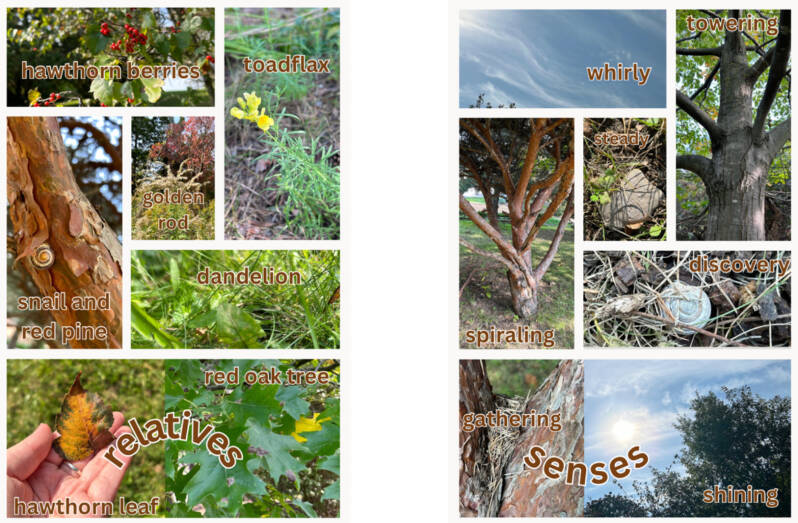
Record the elements below and how they impacted your senses and emotions.
1. Whirly clouds in the sky made me feel thoughtful
2. Gathered pine needles in the tree bark ignited amazement
3. Stone snuggled steady in the ground kindled feelings of safety and trust
4. Sun shining felt warm peace
5. Spiralling branches incited wonder
6. Tall towering tree made me feel small
7. Calcifying snail shell discovered in the ground inspired joy
Record the relatives below.
1. Snail
2. Red Pine Tree
3. Hawthorn tree
4. Dandelion
5. Red Oak Tree
6. Goldenrod
7. Toadflax
Land Acknowledgment Reflection
These statements are historically used to honour and respect the land and its inhabitants past, present and future in their interwoven relationship, but as we see them on school webpages and read aloud in business meetings they are often words on a page. Some people don’t know the names of the Indigenous communities that have resided and taken great care of the lands (past, present and future) where we have made settlements, and this can be a brief and necessary introduction. However, so often they are words that live in our head, and rarely adapted to context or seek to deepen the acknowledgment of the experiences of those communities past the written or read aloud statement.
There is a deeper layer to these statements inherently. Upon their conception the power of the acknowledgement lied in the thoughtful heart of the speaker. They brought collaboration and interconnectedness to light along with the reality of the past, present and future. I find they have the power to elicit an emotional response that aids us in processing the complex reality when given space to do so.
I wish there was regularly more room for our feelings as people, and an emphasis on how we become stronger when we are given structure around that emotional health. When we can accept and process our feelings, we become more compassionate towards others, as it widens our scope of empathizing. This kind of inner and outer connection contributes to neutralized nervous systems, and only from here can people really be reached by a message (when they feel psychologically safe).
I deal with a lot of confusion and guilt around what I'm contributing to as a settler, as a white person, how I'm inherently benefiting from my privilege and how that hurts others. If I didn't write poetry to cope with intense emotions, I would be stinted in these important conversations. I think this is more common than we think, and I want to bring the importance of meeting our emotional needs to the forefront of our mind and encourage folks to take responsibility, make space in their lives for deep reflection. As I move forward in my practice, this is what I will hold dear. I don't think everyone has to be “public” inside our reflection processes but we can certainly acknowledge the necessity of this emotional awareness element.
Learning from and appreciating the land
The environment around me is always teaching me and I am attentive to the cycles. As an artist, astrologer, and tarot card reader, with an interest in the mythological and esoteric levels of meaning or wisdom in everything that we observe around us, I am often looking with a purpose. I seek interaction with the environment to build my understanding. I also find hope and spaciousness when I spend time outdoors. There is a soothing quality when I look out in front of me and just see nature, plant life, seasonal elements. It always allows for my spirit to relax. My body is also pushed by being outdoors. It can be uncomfortable to be active sometimes, to generate inner heat, even anxiety from unpredictable elements or unpleasant sensations, and it can be dysregulating. But for the most part, I when I'm allowed to go slow, I'm oxygenated. I see the sun, I touch the trees, the leaves, my senses are engaged, I feel that spaciousness and I am fed by my environment.
The idea of how I show appreciation to the land and all that encapsulates is a complex issue. I found it was best addressed in poetic writing:
I'm never doing it right, I fear. I don't belong here or anywhere.
Night sky, playing with fire, turning dark.
Why is so hard to feel into light? I want to hide. I'm not good. I promise I'm not right.
Everything I do is designed to hurt people. Incredible guilt, hurt people.
I'm angry I was raised, I chose, I keep choosing, the way that hurts people.
Incredible burden, please lift this heavy life from me.
Heavy body, heavy weight I want to drown, to float again.
Float again, empty no more itch, no more dry, no more tear, no more cries to out there to no one. Incredible weight crush me not them.
Why so heavy, why so hoarse? Why can't I stay bored to this ground this course? Why does my mind betray me? Why do I always betray me? Our world is burning and I betray me. I am so guilty, I am so dreary, I am so haunted, I am still begging round again.
Free me, please free me. I am unhappy. I am so burdened.
Other people's pain strike me down, hurting psychologically break me.
I'm worthy of crush to earth down, down, down, heavy burden.
I wear the bird, earth's skin.
I am her daughter, her son in dress, favorably…
What are the layers here beneath me? The hurting leaves me lonely, the practice makes me write freely, so I see what's in me.
I belong to the earth no one else. I see her smell her on my pungent skin. I am her creature.
When I set down the bargain I am nothing but her leaves. I see her flush all around me, I reflect upon it often.
Our houses, stones, wooden buildings it's impossible for it not to come from her.
Her designs through us mixed with will of our own, she is wise, she teaches us we all belong.
I wish to lay down my words and silently listen. I have picked trash from the park, and I still do sometimes when I come visit you, my heart holds big storms. I regret what I say, but when I open my mouth to speak now, I say thank you.
So, I find myself thanking the earth by seeing all of myself and seeing all of her. These are processes that happen in tandem for me. Her storms, her feelings, her processing of our mistakes that play out happening through me, or rather as me... I'm present to her beauty and fullness in the way I can be, and it is limited as my perception and stories I uphold, choices I then make… but I see me, us, and want to help. So we are in it together. Not just her and me, but all of us, all of her creations. I want to learn about her. I want to help her creation survive, feel whole inside and nurtured, but it can be really, really hard. I find immeasurable beauty in the widening philosophy of all this…new ways to perceive what is happening around me, but sometimes I think that perception might be an escape. By imagining a liberated truth to the point where I've lost it, I've lost our pain, and we need our pain, don't we? We might need it as much as the decadent connection. From here, widening, considerate awareness, I'm finding ways to help because I really, really want to.
My land acknowledgment and positionality is long and a bit poemy, but it is true:
Dear earth, I meet you today, free of dismay, my heart to hold, you know it's old, you know its design, you know it's mine, what I crave, what I submit to bear. You feel how my ancestors survived.
I don't know what their lives entailed, but I'm sure they weren't always respectful, just like me. We stepped on backs, trekked our tracks from lands far to get where we are, where they delivered me. Spoon fed, made bed, had their respect, even if I didn't earn it in some cases and then some I didn't, and I was treated badly.
The guilt is intense. I don't want to bypass it. I feel it. I am not all beauty, and neither are you.
In my sheltered way, earth I see you, this land so long taken special care, great wisdom, humanity continuity there, the peoples called Anishinaabe, Haudenosaunee, Wendat, and all their relations, descendants, carry those stories of ugliness, pain, what disrespect, what trials they were put through, thousands of years back and still, they remain.
Winds, waters, sunlight, grass stains, carry it all, and I carry the same elements, but slightly different, rearranged.
The earth sees all of us and wants to feed us the same.
We keep food out of each other's mouths. We put hands on each other's pouch, packs of culture and story and gold, and we steal what is valuable.
The world, the earth feels it all. That's as far as I've got the earth is bearing witness and fighting back through us. The Anishinaabe, Haudenosaunee, Wendat peoples continue to caretake the land, teach their ways to their families and stand up to injustice. I don't come from Adoobiigok, the place of the alders and the Michi Saagiig language, which makes me a guest. Therefore, I must listen, the land and its story as an entity with original caretakers and treaties that hoped to seal that respectful treatment therein, but it wasn't, and it still isn't. A lot of this land was unceded, or stolen and developed upon, depleting its spirit, riches and original caretakers; Indigenous people are hurt with it.
We do not benefit in our spirit. We are hardened, left fending for a place in the world to love, to feel connected to. It's gone, not forever, but as frightening as it is, we do not really know like we used to.
A lot of us are quietly living in the place we get and just hope to survive. I want more for us as a community, as new generations begin. I want to tend to mutual aliveness.
There are many ways to do this, but do it we must. That is key. Keep listening to those who know— who haven't had the privilege we have.
We are a smaller community than we think, those of us sheltered from poverty, from the world being angry at us for no reason. People can be unkind to my fellow LGBTQ2SI+ people. But there are big variances; yes, it can be violent for me, but I'm safe in life. I am treated unfairly less than many of my peers.
We have to look out for each other, find a way to be revolutionary with our listening and generosity, time and energy can make this universe a different place. We want the hurt to stop. I want the hunger and robbery of culture to not ever strike again. So, I put food in my hands, bite, and pass it along, more than I need, pass it along.
I am overwhelmed by everything, the beating, burning pressure of everything, but I can still feel, I can still breathe. I can make it through my hardships and revel in ease; in what's possible. Dream, night time, laughing, bending with me. I suppose I need to see that layer to really meet me.
Dear earth, another day I don't forget to feel your way of living through me. I belong. I survive as you through me.
Add comment
Comments